When it comes to vision, nature is both diverse and innovative.
Animals have evolved an array of visual abilities that often far surpass human capabilities, tailored to their unique environments and survival needs. This blog post explores some of the most intriguing differences between human eyesight and that of various animals, shedding light on nature’s ingenuity.
1. Eagles: Masters of Sharp Vision
Eagles are renowned for their exceptional eyesight, often cited as being four to eight times sharper than that of a human. What sets eagles apart is their high number of photoreceptors in the retina, particularly cone cells, which enable them to see fine details from great distances. This acute vision is crucial for spotting prey from several kilometers away. Eagles also have a deep fovea, a small pit in the retina packed with cone cells, which gives them a magnified view of distant objects, much like a telephoto lens.
2. Mantis Shrimp: A Spectrum Beyond Our Imagination
The mantis shrimp is another creature with extraordinary visual capabilities. While humans have three types of color-receptive cones (red, green, and blue), mantis shrimp have sixteen types of color receptors, including ones for ultraviolet light. This complex visual system does not necessarily mean they see more colors; instead, it allows for rapid color differentiation, which is crucial in the quick, murky, and competitive environments they navigate. Their eyes, which are mounted on mobile stalks and can move independently, also allow for a 360-degree field of vision.
3. Cats: Nighttime Hunters
Cats have eyes that are highly adapted to low-light conditions, making them efficient nocturnal hunters. Their eyes have a high number of rod cells, which are more sensitive to low light than cones. Additionally, cats’ eyes include a special reflective layer behind the retina called the tapetum lucidum. This layer reflects light back through the retina, enhancing vision in dim light by providing the photoreceptors with a second chance to absorb light. This adaptation gives cats their characteristic eye shine when light hits their eyes in the dark.
4. Butterflies: Seeing the Ultraviolet
Butterflies have vision that extends into the ultraviolet (UV) spectrum, which is invisible to humans. This ability plays a crucial role in their survival and social interactions. Many flowers have patterns that are only visible under UV light, helping butterflies locate nectar. Moreover, the UV light also highlights patterns on the wings of other butterflies, which aids in mate selection and territorial disputes.
5. Chameleons: Panoramic Vision
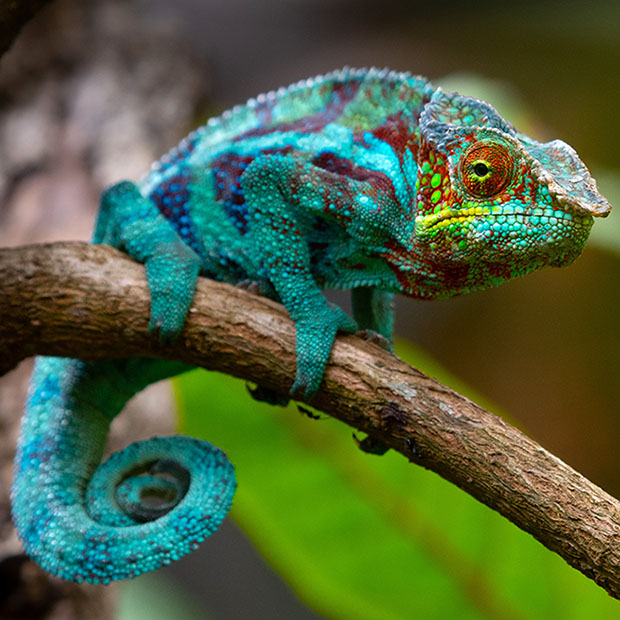
Chameleons possess perhaps one of the most unusual eye arrangements in the animal kingdom. Each eye can swivel independently, allowing them to look in two different directions at once. This panoramic vision helps them spot predators and prey without moving their heads, maintaining their camouflage. When a chameleon focuses both eyes in the same direction, it achieves sharp stereoscopic vision and depth perception, which is crucial for judging distances when striking prey with their tongues.
6. Snakes: Infrared Detection
Some snakes, like pit vipers, boas, and pythons, have pits on their faces that aren’t traditional eyes but serve as infrared detectors. These pits are sensitive to the heat emitted by warm-blooded prey and can detect variations in temperature as slight as 0.003 degrees Celsius. This ability allows these snakes to “see” in the dark and accurately strike at prey based on their body heat.
There Are So Many Fascinating Eyes Out There!
The diversity of animal eyesight is a testament to the intricacies of evolution, driven by the varying demands of survival in different environments. From the sharp-eyed eagle and the color-savvy mantis shrimp to the night-prowling cat and the heat-sensing snake, each animal’s vision is a unique adaptation to its lifestyle. Understanding these differences not only fascinates but also provides insights into how vision could evolve and be manipulated for various applications, including enhancing human visual capabilities in the future.